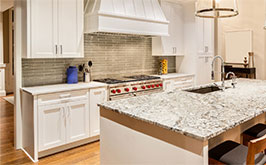
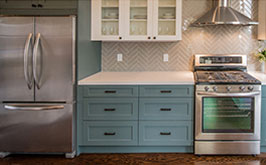
Backsplashes do more than just protect the walls from grease and cooking
splatter. Backsplashes are a wonderful way to jazz up your kitchen with an
element of style that reflects your personality.
Considerations:
Generally, you have about 18.5” to work with from the top of the countertop
to the bottom of the cabinets.
- Sometimes, behind a cooking surface you will have more room to tile between
the countertop and the hood or microwave - You can tile from the countertop to the bottom of the top cabinets or from
the 4” or 6” backsplash that matches the countertop. Keep in mind, this limits
your space to tile to approximately 12-14”. This can be helpful or not so
helpful depending on the size of your tile. - If you choose a decorative pattern for your tile, remember items like pot
fillers that can end up right in the middle of your decorative pattern! - Choosing to mix different tiles to create a pattern in encouraged, but be
careful about mixing tiles with different thicknesses. Check with your tile
designer or tile setter to see if your choices will work together for a smooth
installation. - Textured tiles or 3 dimensional tiles with patterned reliefs are beautiful –
if you are not the person that has to clean them!
Options:
- Finishing the tile – be sure to find out if the tile you select has a
coordinating bullnose to finish off the edges of the last piece of tile. - If your upper wall cabinets do not end on the same line as your base
cabinets and countertop, be sure to clearly choose a stopping point for the
tile. - Using a sealer for your grout to help staining
- If you choose not to seal your grout, be sure to choose a color that will
hide kitchen stains the most.
Backsplashes can be made from the following materials:
- The same material as the countertop, i.e. tile, granite, solid surface, etc.
either 4” or 6” high or from the countertop to the bottom of the cabinets. Not
very exciting, but practical. - With some surfaces like solid surface countertops the transition from the
countertop to the backsplash can be seamless. This is helpful from a maintenance
standpoint. - Granite, marble or other natural stone tiles
- Ceramic or porcelain tile
- Mosaic tiles
Decorative Design Options:
- Set the tile square or straight lay with no added options
- Set the tile at a 45 degree angle or on the diagonal
- Set the tile with a brick joint or running bond pattern
- Add a decorative listello at the top, bottom or both (straight or diagonal
lay) - Clip the corners of the tiles turned on the diagonal and insert a decorative
“dot’ made from tile, metal, glass or stone. This works best with a 4” or 6”
tile - Alternate colors to make a checkerboard pattern
- Mix some of the elements above and set the tile straight, but turn one row
in the center on the diagonal. This can be outlined with a listello at the top
and the bottom of the diagonal band if you have room or a decorative dot can be
inserted in between the diagonal tiles. - If you have a large enough area behind the cooking surface, add a feature
like a decorative picture frame. This can be created with a listello as the
frame and it gives you the option of the choices listed above to accent the
interior. - Solid mosaic backsplashes can be a timeless choice with an element of
“punch” that will be great for you and good for resale as well.